Twenty some years ago, my mother, Margaret Spence, passed away from cancer, leaving behind a home that used to hum with vocal harmonies, piano chords, and the unmistakable rustle of watercolour paper.
To understand my mother’s creative legacy is to understand her journey. Born and raised in the misty, industrial air of Paisley, Scotland—a legendary hub of textile manufacturing—she crossed the Atlantic to Toronto in her late teens. She landed her first job doing administrative support for what is now the Toronto Dominion Bank, but while her days were filled with ledgers, her heart was entirely wrapped in the arts. She sketched, painted in oils, crafted, played the guitar, organ and piano, and had a singing voice that could find the perfect harmony in any room.
She was known for putting a creative, loving touch on everything she did. Nowhere was this more evident than in her piano lessons. In her later years, with growing confidence, she began teaching children, specifically gravitating toward those with learning challenges like dyslexia or autism. Her patience with these students was incredible. The bond was so deep that whenever those children saw my mother—primarily at our congregation meetings—they would run up and embrace her as if she were their own mother. She taught them notes and scales, but more importantly, she showed them acceptance and confidence.

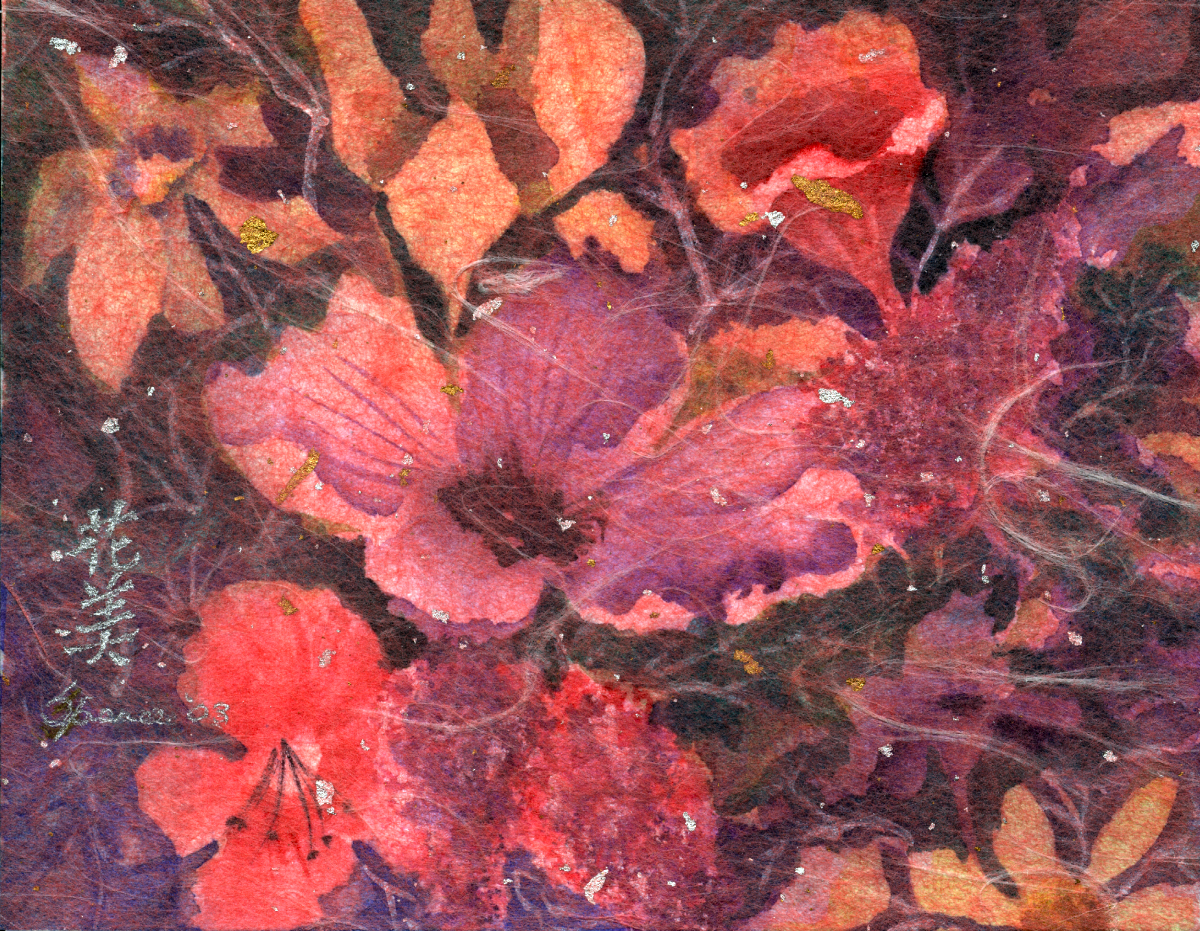
This piece perfectly captures the “interrogative love” my mother had for nature. The “salt-like” textured wash in the background reflects her atmospheric freedom, while the delicate focus on the petals shows the “incredible” patience she practiced while observing the smallest details of creation.
The Great Accordion Conspiracy (and the Legend of Ted)
While my mother had to practice like mad to master the piano, I inherited an ear that allowed me to hear a tune once, sit down, and play it within minutes. It remains one of the most joyous gifts of my life. However, looking back, I suspect she was a bit “thrilled” in a different way by my effortless playing.
Instead of the piano, she enrolled me in accordion lessons with a man named Ted. Ted was a musical master at both the accordion and piano, but he was also grumbly and stern—ultimately scaring me away from the lessons. Yet, when Ted sat at the piano during our congregation meetings, it was a different story. We felt like we had front row seats in a concert hall. His flourishes were reminiscent of Liberace, mesmerizing us all and turning a simple hymn into a masterclass of technique. I often wonder if my mother gave me the accordion just to see if I could find the music through the wheezing bellows and Ted’s stern gaze.
This piece feels like a memory of home, perhaps inspired by her restoration projects. It echoes the same creative care she took in painting a bouquet inside the lid of an old sea chest to give it “former glory.”

The Outdoor Classroom: Sea Chests and Apple Wood
Back when I was two, our family’s journey took us to Alaska, where my mother fell in love with the wildness of the landscape and the deep warmth of the people. While we lived in a few homes over our 8 years in this wild North, our semi-remote one about 30 minutes outside Fairbanks was the perfect spot for a child to grow up. I was outside playing constantly, making tree forts (snow forts in the winter), picking berries and even hitching rides on a small plane owned by a neighbour. He had created a landing strip at the foot of our properties and sometimes would invite my dad on short trips. Thinking back, it makes sense that my nature-loving mother would love this environment.
But the crashing ocean waves and coastal storms of her Scottish youth called to her. So, we moved across the continent to Prince Edward Island and Nova Scotia. PEI became a special place for the birthing of my own creativity. My mother loved beachcombing, turning our walks into lessons on observation. I would marvel at how much time she could spend watching the sparling waves or rolling a sand dollar in her hand, noting how the light would hit or how its texture felt.
She once uncovered an old, weathered sea chest that likely belonged to a sunken ship. She spent months restoring it—stripping rot, sanding it to its former glory, and turning it into a hope chest for my sisters. But she didn’t stop at restoration; she added her own touch, insetting an oval-shaped oil painting of a bouquet of flowers into the inside of the lid.
Her creativity truly knew no bounds. In Nova Scotia, when a few failing apple trees had to be cut down, she and my father collaborated to save the wood. They smoothed and varnished slices of the apple wood, but first, my mother painted beautiful oil images directly onto the grain. These tiny preserved masterpieces were sold at local markets or given as heartfelt gifts to friends.
In those childhood days, our coffee table books included a 1965 copy of Rachel Carson’s The Sense of Wonder. I spent countless hours dreaming through its pages that were filled with large photos of leaves, ponds, giant trees and ocean waves. For those unfamiliar with this popular work by Carson, she focused on using nature to teach children. Recently, I purchased a copy for my own home. Having it back in my life feels like a direct connection to her—a reminder of the finely honed curiosity she passed down to me.

The PEI “outdoor classroom” in a single image. This is where she taught me to observe the textures of a sand dollar and the light on a wave—a “finely honed sense of wonder” that eventually led me back to my own creative path.
A Legacy of Creation
It was this finely honed sense of wonder that led me to a life defined by over a dozen hobbies. Following in her footsteps (and the artistic branches of my father, who was a lyricist and guitarist), I became a professional photographer, author, videographer, poet, graphic designer, and voice actor. I’ve explored theatrical stage management and acting from Vancouver to the Edinburgh Fringe Festival, all while keeping that “creative gene” alive.
A central piece of this puzzle was my mother’s faith. For most of her life, she was one of Jehovah’s Witnesses. While religion is highly personal and a subject some may prefer to avoid, for me, it was a literal lifeline. My siblings and I were raised in this faith, though I left it behind in my late twenties and spent nearly three decades charting my own course.
During that time away, I lived, worked, and traveled throughout the UK and Europe. It was a period of incredible exploration where I was able to connect deeply with my mother’s side of the family tree. I also partied away the nights, weeks, and years in London with a vibrant circle of new friends, crossing paths with quite a few celebrities and VIPs. One of those was George O’Dowd—better known as Boy George. I frequently ran into him at club nights, fashion week events, and fundraisers over my years in London. While I would never claim we were close friends, we did share a few truly meaningful conversations.
One in particular sticks out. I was attempting to write a book about my life travels, and he had recently published something similar. He graciously offered tips on writing, urging me to stick with it and be entirely honest. More importantly, he advised me to ground myself on a spiritual foundation. Little did I know how vital that advice would become as I tried to marry my overseas adventures with the dark, chaotic reality of navigating drug addiction.

For the nearly three decades I drifted from the religion of my youth, my life was often chaotic. Yet, my mother’s faith remained a quiet anchor in my subconscious. I couldn’t help but think that if someone as intelligent, creative, and profoundly loving as she was believed so deeply, her faith must hold essential truths. And so it was that, in time, I decided to honour her legacy by studying the Bible with honesty, opening my heart to its beautiful message.
That decision has been a profound blessing, improving my mental health and giving me a hope that no medication or counselor ever could. I see my mother’s wisdom in her love for her Creator, Jehovah. As she knew, if art imitates life, then creation reflects the Ultimate Artist. Observing creation while getting to know this Master Artist and Therapist continues to bring me incredible joy and peace.
This botanical study shows her eye for detail and texture. It is a visual testament to her belief that “if art imitates life, creation reflects its Creator”—an intricate, loving look at the world’s design.

Hummingway and the Garden
I see that reflection of a loving Creator today in the garden that surrounds my home in East Vancouver, where I’ve helped create a habitat for pollinators. The resident hummingbird, “Hummingway,” has become a constant friend. He will hover inches from my face and chirp until his nectar is refilled, watching the process with what seem like happy, excitable chirps. In those moments, I have a richer understanding of my mother’s hours spent staring at a sand dollar. It’s all connected.
The Freedom of Northern British Columbia
In her later years in 100 Mile House, Northern BC, my mother truly leaned into watercolours as her main hobby. While she had explored the medium before and was largely self-taught, in this season of her life she was finally free with her expression, unconcerned with critique. These works (including the gallery below) are my favorites because they represent a heart that was comfortable in its own skin and its own wonder. They are the visual diary of a woman taking joyful notes on the Ultimate Artist’s masterpiece.

One of her most evocative works, capturing the “freezing temperatures” and “warmth” of the North. The splattered snow is a playful, self-taught technique that brings a sense of life and motion to the solitude.
The Gallery
Twenty years after she passed, the colors she left behind still have so much to say. I hope her work inspires you to look a little closer at the “apple wood” in your own life—to restore, to create, and to never stop wondering.


Leave a Reply